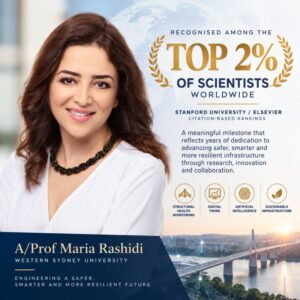
Associate Professor Maria Rashidi recognised among the world’s top 2% of scientists
A/Prof Maria Rashidi of Western Sydney University has been recognised among the world’s top 2% of scientists in the citation-based rankings developed by Stanford University and Elsevier. The recognition marks an important milestone in her academic career and reflects her contribution to research in infrastructure engineering.
Maria describes the recognition as a meaningful milestone, built through years of dedication, collaboration and perseverance. She also looks forward to mentoring emerging researchers and translating research into outcomes that benefit industry and society.
Maria’s work focuses on structural health monitoring, digital twins, artificial intelligence and intelligent infrastructure management. These fields are increasingly important as communities seek to maintain ageing infrastructure, respond to changing conditions and make informed decisions about the safety and performance of essential assets.
Structural health monitoring uses information from inspections and sensors to help assess the condition of structures over time. Digital twins connect information about a physical asset with a digital representation, while artificial intelligence can help researchers make sense of complex data and identify patterns. Combined, these approaches can support better-informed decisions about how infrastructure is managed and maintained.
Maria is the Chief Investigator on the RIIS project Development of Intelligent Bridge Management Systems (iBMS) Using Digital Twins and Decision Support Systems, which involves the Institute of Public Works Engineering Australasia (IPWEA). The project aims to bring together diverse bridge monitoring data in a digital twin and use an artificial intelligence-based decision support system to help guide bridge maintenance and remediation planning. It addresses a gap in current bridge management systems: the need to integrate monitoring information and turn it into practical, reliable management decisions.
The project brings together researchers from Western Sydney University and the University of Melbourne, with IPWEA represented by Partner Investigator Joshua Devitt. It reflects the collaborative approach Maria identifies as central to research: connecting expertise, working with industry and translating research into practical outcomes.
The RIIS community congratulates Maria on this achievement and celebrates her contribution to research that supports safer, smarter and more resilient infrastructure.