View Presentations here See below for timings of specific topics of interest
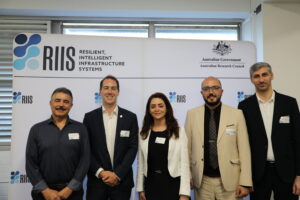
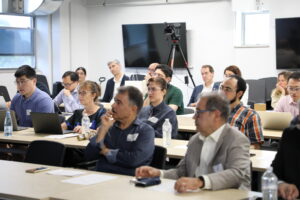
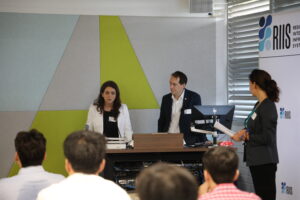
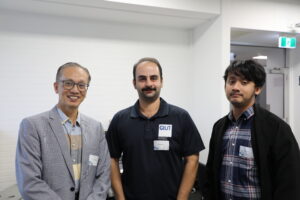
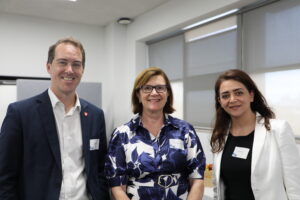
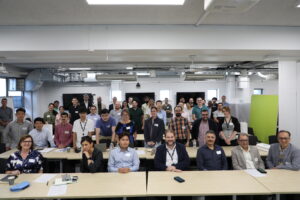
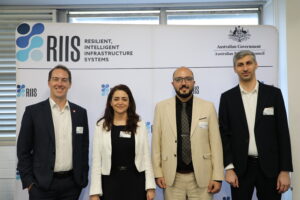
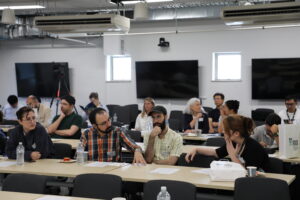
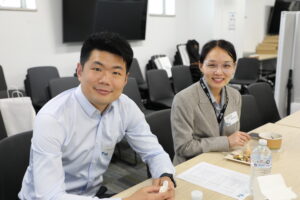
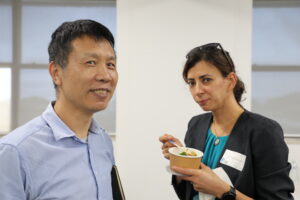
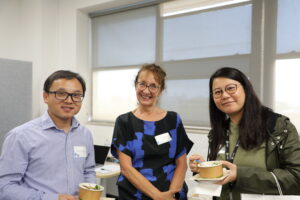
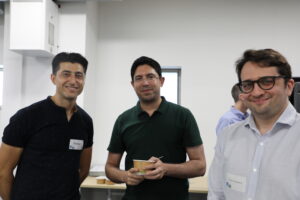
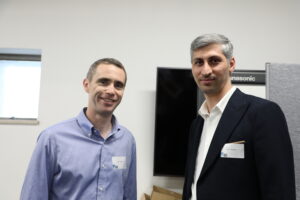
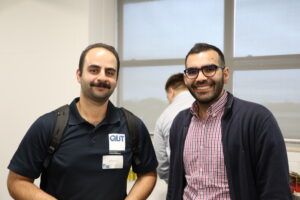
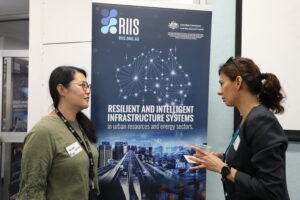
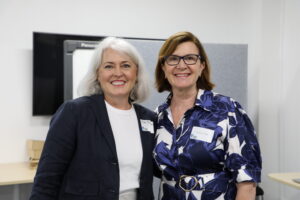
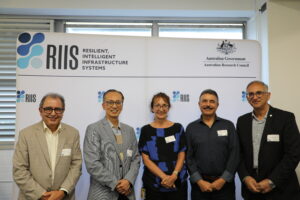
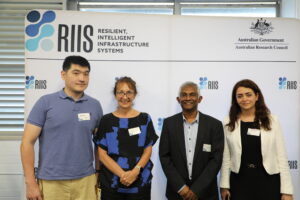
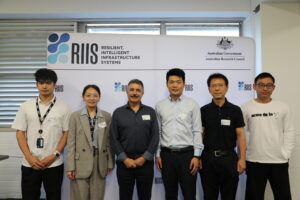
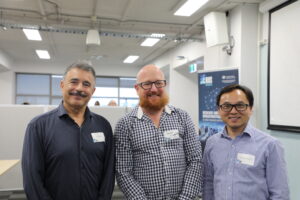
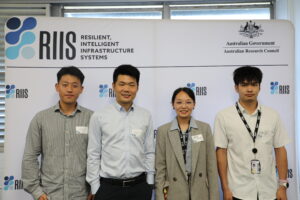
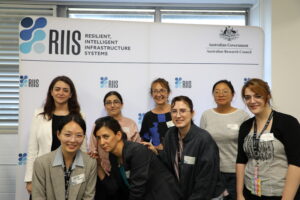
On 18 March 2026, the RIIS Hub (Resilient and Intelligent Infrastructure Systems) brought together researchers and industry partners in Sydney for its annual Review & Presentation Day—marking an important transition from research development to delivery and integration.
The event welcomed representatives from UNSW Sydney, UNSW Canberra, the University of Melbourne, QUT, and Western Sydney University, alongside a strong cohort of industry collaborators. Together, participants shared insights, explored opportunities, and strengthened the partnerships that underpin RIIS’s impact.
From Research to Real-World Delivery
As RIIS projects mature, the focus is increasingly on translating research into practical, deployable solutions for Australia’s infrastructure challenges.
Throughout the day, project teams shared:
*Key milestones and progress updates
*Emerging technical innovations
*Clear pathways for implementation and industry integration
Industry partners played an active role in discussions, helping to ensure strong alignment between research outcomes and real-world needs.
“What stands out most is how the RIIS Hub is effectively bridging the gap between research and industry application. From our perspective, this alignment is critical.”
— Shuangcheng Dai, Industry Partner
Innovation Across Infrastructure Systems
The program showcased a diverse portfolio of research spanning energy systems, digital infrastructure, and asset integrity.
Highlights included:
Energy harvesting technologies for infrastructure monitoring
Digital twins for bridges and smart asset management
Geospatial intelligence and automation
Robotics and sensing for challenging and remote environments
Modelling tools supporting resilience in climate and cyber-physical systems
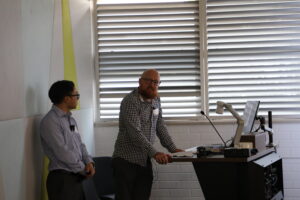
Industry perspectives were also a key feature. Joshua Devitt (IPWEA NSW & ACT) presented on NSW local government bridge challenges, including insights from the IPWEA Bridge Panel, current projects and initiatives, and collaboration with Western Sydney University and the RIIS Hub.
James Linke (GeoAI – Geospatial Artificial Intelligence) co-presented with UNSW on automated construction progress monitoring using Scan-vs-BIM and SLAM LiDAR, alongside advances in mobile laser scanning, material detection, and 3D digital twin visualisation. These applications demonstrate how AI and geospatial technologies are enabling more accurate, real-time insights for infrastructure delivery and asset management.
Together, these contributions highlight the importance of collaborative, cross-sector approaches to addressing infrastructure challenges.
Collaboration Driving Impact
Collaboration remains at the core of the RIIS model. The event created space for new ideas, deeper connections, and future partnerships to emerge across the network.
Looking Ahead
The Review & Presentation Day provided a strong snapshot of progress—and a clear view of what comes next.
RIIS continues to deliver on its mission:
developing practical, impactful solutions to address current and future challenges across Australia’s urban, resource, and energy infrastructure systems.
“A very well-organised and insightful set of events—we look forward to the next phase of collaboration.”
— Shuangcheng Dai, Industry Partner
View Presentations here
Topics and Video timer
Session 1 – Energy, Reliability & Intelligent Systems
| Title | Presenter | Timer | |
| 1 | Energy Harvesting in Civil Infrastructure for Wireless Sensor Nodes | Saif Ur Rehman | 10:02 |
| 2 | Industry Collaboration | Joshua Devitt | 20:20 |
| 3 | Multifunctional Triboelectric Nanogenerators for Infrastructure Monitoring & Energy Harvesting | Ali Martin Nazar | 27:25 |
| 4 | Intelligent Bridge Management Systems (iBMS) Using Digital Twins | Vahid Mousavi | 36:40 |
| 5 | Real-time Downhole Characterisation & 3D Reconstruction | Stuart Clark | 54:00 |
Session 2 – Digital & Intelligent Infrastructure
| Title | Presenter | ||
| 6 | Infrastructure Protection – Flash Flood Modelling | Alireza Haji Heidari | 1.08:20 |
| 7 | Spatial Digital Twin & Automation in Smart Asset Management | Masoud Kamali | 1.16:00 |
| 8 | Digital Twin – Bridge Case Study Demonstrator | Maryam Nasim | 1.31:30 |
| 9 | Geospatial Intelligence for Machine–Human Interaction | Rabindra Lamsal | 1.46:30 |
| 10 | Simulating 3D Fire Propagation in Voxels (AAS) | Sisi Zlatanova | 1.3:55 |
Session 3 – Applied Monitoring & Asset Integrity
| Title | Presenter | ||
| 11 | Automated Scan-vs-BIM for Construction Progress | Johnson Shen | 2.09:10 |
| 12 | Remotely Operated Submersibles for Pier Defect Detection | Will Midgley | 2.21:35 |
| 13 | Underground Navigation and Obstacle Avoidance for Unmanned Equipment | Licheng Feng | 2.33:30 |
| 14 | Nanosensor Integration for Safe Mining | Camille Zhou | 2.38:45 |
| 15 | HVAC Degradation Modelling | Tam Husain Syed | 2.51:25 |
| 16 | Rail Reliability Modelling & Maintenance Decision Support | Saeed Khalaj | 2.59:25 |
| 17 | Porous Media Properties | Peyman Mostaghimi | 3.11:23 |
| 18 | Structural Integrity of Port Systems | Mohsen Mousavi | 3.22:00 |
| 19 | Building Resilience to Cyberphysical Power Systems (CPPS) under Climate-related Disasters | Huadong Mo | 3.35:15 |